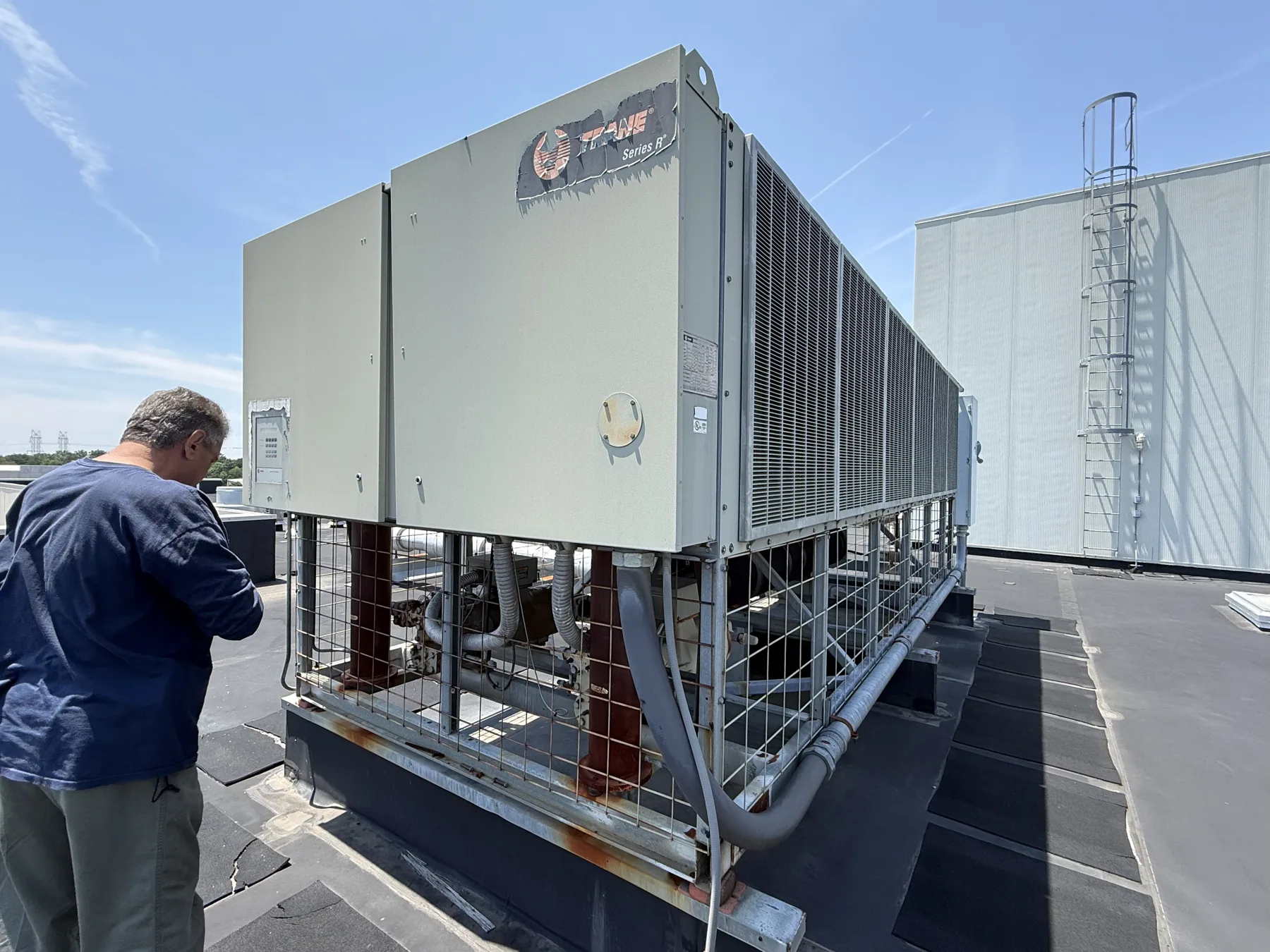


If you need to sell a Multistack chiller in Parkersburg, WV, start with the equipment you actually have, not an assumed market value or a test run. We buy commercial and industrial chillers from 20 tons to 2,000-plus tons, including air-cooled and water-cooled units. Our buying process includes cash offers and upfront payment, and a test is not required. The guidance below explains how to identify the machine and prepare for removal.
Identify the Multistack chiller
For a Multistack chiller, show the entire group of modules as well as the identifying plate on each piece available for sale. Tell us how many modules are included and whether they are still connected to a common frame or piping. Do not assume a single nameplate describes the combined capacity of every module in the bank.
If modules have different histories or some have already been disconnected, label the photographs and explain the differences. A sketch or inventory can be useful when only part of an installation is being retired. We will review the described equipment without an operational test, using the details you have rather than requiring a perfect record set.
Consider the needs of a school or education facility
A school or education facility may need to coordinate work around classes, events or an unoccupied period. Identify the equipment owner and the person authorized to arrange the sale, then describe any site-entry and scheduling requirements. Note whether other chillers must remain available during the work. Those details help plan a removal without assuming that every campus has the same equipment or calendar.
Identify each machine separately
For a multi-unit sale, give each chiller a simple number and use the same number on its plate, overall photo and condition notes. Tell us whether capacities are individual ratings or a combined figure. An existing inventory is helpful, but a short handwritten list can work too. Separate identification lets the discussion focus on the equipment actually being offered.
Working from a mechanical room
An interior plant room calls for a look at more than the equipment footprint. Describe doors, corridor turns and changes in floor level between the chiller and the outside, if known. Indicate whether nearby equipment must stay in service. Existing drawings and a few safe photographs can help the removal team plan; you do not need to cut a path or dismantle the machine before asking for an offer.
Working around an active plant
If the rest of the cooling plant must stay in service, identify the chiller to be removed and explain the boundaries around active equipment. The site team can flag operating constraints and preferred work windows. Do not disconnect shared piping or electrical equipment yourself to accelerate the sale. We cover disconnects and coordinate the removal scope for the unit being purchased.
Read capacity and electrical information separately
Tons describe cooling capacity, while a motor or electrical rating describes a different characteristic. Do not convert an electrical number into a chiller capacity by assumption. If the plate lists several values and you are unsure which applies, send a clear photo rather than choosing one. For a plant with multiple machines, distinguish the individual unit's rating from any aggregate capacity shown on a building schedule.
What to tell the removal coordinator
Identify the chiller's location, the site contact and any restrictions on working hours or the route to a truck. We cover rigging, a crane when needed, disconnects, refrigerant recovery, loading and freight. Existing measurements or drawings are useful, but do not guess at the weight. The removal method is planned for the actual machine and verified site conditions.
Contact the buyer directly
For a cash offer, text photos and a description of your chiller to (614) 715-3047. We buy industrial chillers from 20 tons to 2,000-plus tons and provide upfront payment for a purchase. We do not ask for an operational test and do not sell chillers. Mention the equipment's location, condition and any known removal constraints in your first message.
Review the site constraints
Before removal, share the site rules that apply to work hours, access, traffic and protection of nearby equipment. If the route crosses another tenant's space, identify who can approve it. The precise plan depends on the machine and the facility. Accurate information early in the discussion is more helpful than promising a clear route that has not been checked.