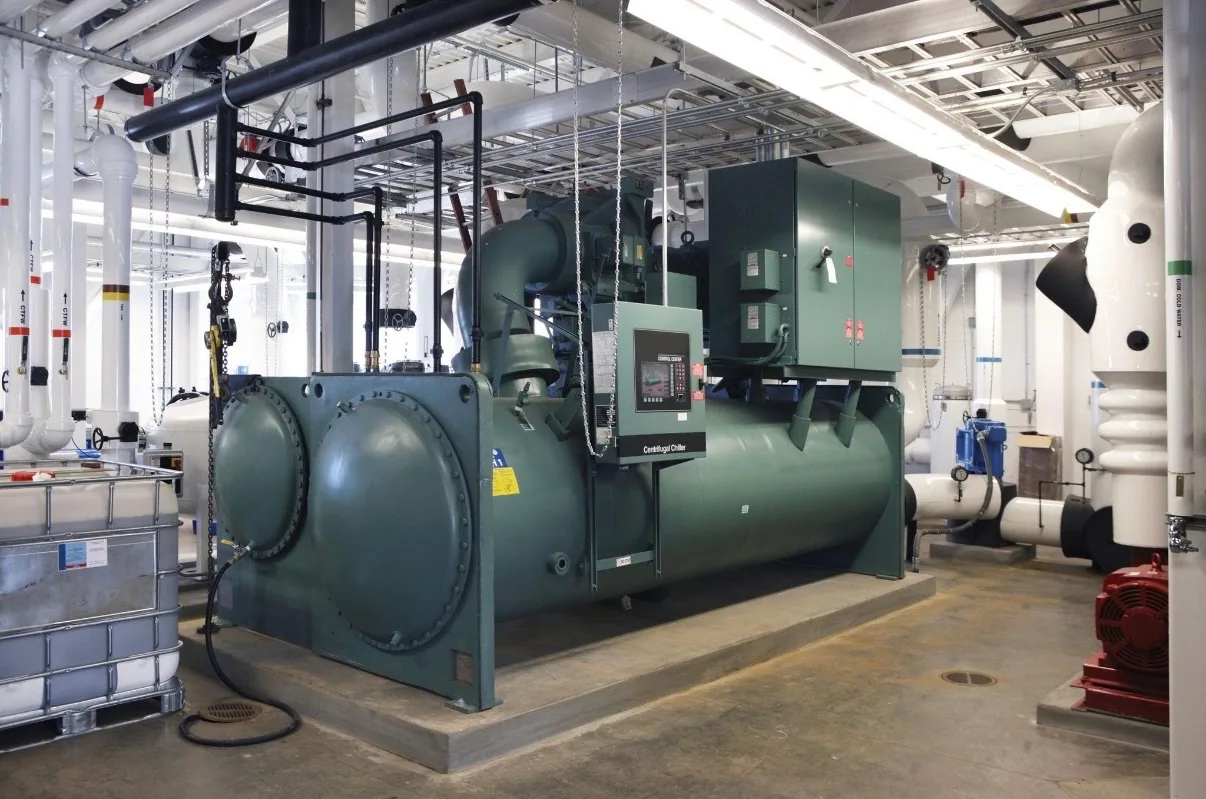


Facilities in Beckley, WV can contact us about selling a Daikin chiller, even if the machine has already been retired. We buy air-cooled and water-cooled industrial chillers from 20 tons to 2,000-plus tons and provide cash offers and upfront payment. Testing is not required. Explain the machine's condition and what is included, then identify any access needs so the covered removal can be coordinated around the actual site.
Identify the Daikin chiller
When identifying a Daikin chiller, capture the manufacturer plate and enough surrounding equipment to show how the assembly is arranged. Report the model and serial numbers as written, even if the building inventory uses a different shorthand. If a replacement component carries another label, photograph that plate separately rather than assuming it identifies the entire chiller.
Tell us whether the equipment is air-cooled or water-cooled if you know, along with the approximate capacity and whether the controls are present. A machine may have been modified during its working life, so mention relevant changes and use the existing records as clues, not guarantees. We do not require an operational test.
Consider the needs of an office building
At an occupied office building, decide which chiller is included and whether an active tenant, parking area or loading dock affects access. The facilities team can flag building rules and the best contact for coordinating work. A photograph of the machine and its plate is more valuable than trying to estimate how much office space it once cooled. An operational demonstration is not needed.
Clarify equipment ownership
Before a sale is finalized, confirm who owns the chiller and who is authorized to transfer it. The building owner, tenant, property manager and maintenance contractor may have different roles. If the equipment is part of a larger replacement project, specify what is included and who controls access. Clear ownership and a named site contact prevent delays without requiring the machine to be tested.
Considering a tight equipment yard
An outdoor equipment yard may contain fences, piping, curbs or other units that limit access. Take a wide picture from a safe position and note any gates or sections that cannot be disturbed. Show where the chiller ends and neighboring equipment begins. A clear boundary helps the removal discussion without assuming the machine can simply be rolled onto a truck.
If replacement is already planned
When a replacement project is underway, identify when the old chiller will be available and whether the new equipment must remain in service during removal. Coordinate the seller's project contact with the person responsible for building access. Do not assume that a construction date automatically establishes a clear exit route. A proposed window and current site photos allow the removal conversation to start early.
If parts have already been removed
A partially dismantled chiller can still be described for a purchase discussion. Make a simple list of components that remain on the machine, items stored separately and parts that are missing or not for sale. Label the corresponding photos and provide the equipment location. There is no need to reassemble or operate it to request an offer. Accurate scope helps the buyer understand what would actually be collected.
A practical removal discussion
An offer discussion can include the equipment's current location and how a crew could reach it. We cover rigging, crane service when needed, disconnects, refrigerant recovery, loading and freight. Let us know about occupied spaces, gates, plant-room doors or roof access, as applicable. The actual plan will depend on the unit and site, not an assumed standard procedure.
Request an offer from photos
Send the nameplate, a whole-unit photo and a short description to (614) 715-3047. Include the West Virginia location, condition and the best contact for access. We buy rather than sell chillers and can make a cash offer with upfront payment. You do not need to run a test, repair the chiller or obtain a new performance report before reaching out.
Use one inventory for multiple units
When selling several machines, keep an inventory with the same identifiers used in your photographs. Include each unit's location, model and capacity if known, plus the related loose parts. Mark units that are not for sale. This makes it easier to coordinate a staged pickup and avoids confusing a plant-wide capacity with the equipment included in one purchase.